
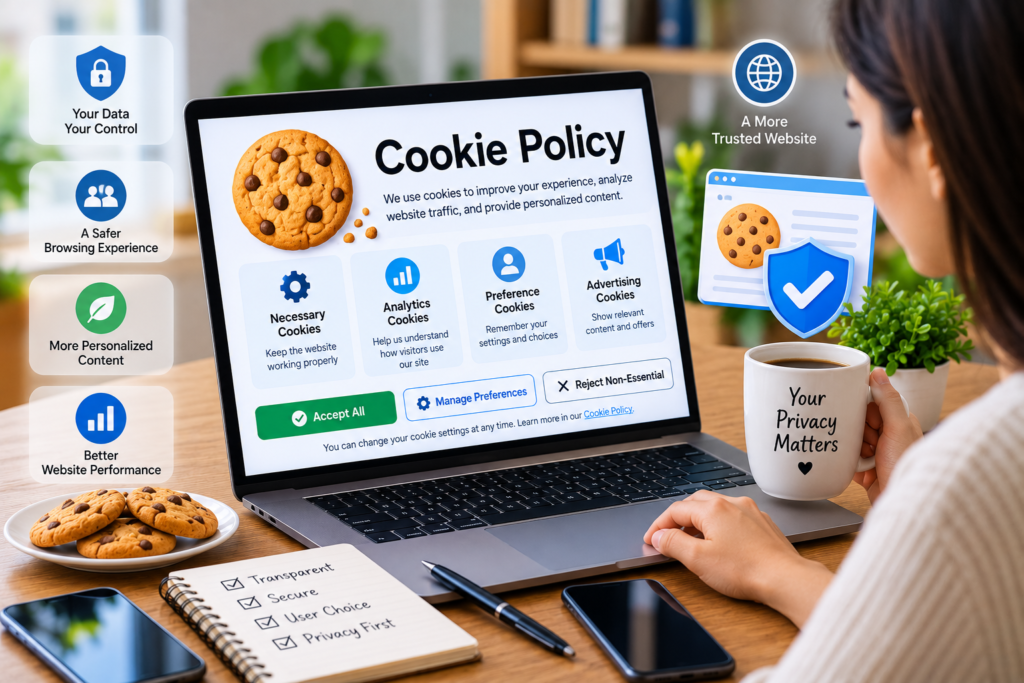
Cookie Policy Explained: 10 Essential Rules Every Website Owner and Online User Should Know
Introduction
Have you ever opened a website and immediately seen a message asking you to accept cookies?
For many people, cookies seem like a small technical detail. In reality, they can affect website functionality, analytics, personalization, advertising, and online privacy.
That is why a clear Cookie Policy matters.
A Cookie Policy explains what cookies and similar technologies a website uses, why they are used, how long they remain active, whether third parties can access information, and how visitors can manage their preferences.
For example, cookies can remember shopping-cart contents, login sessions, language preferences, and website settings. They can also support analytics and, depending on the technology and legal framework involved, tracking or advertising. The UK Information Commissioner’s Office (ICO) explains that modern rules can also cover technologies beyond traditional cookies, including tracking pixels, link decoration, web storage, scripts, tags, and fingerprinting techniques. (ICO)
The regulatory environment is also evolving. In April 2026, the ICO finalized updated guidance covering cookies and broader “storage and access technologies,” reflecting changes introduced by the Data (Use and Access) Act. The ICO also reported that 99% of the UK’s top 1,000 websites were meeting its cookie-banner compliance standards following its work with industry. (ICO)
Whether you run a blog, ecommerce store, affiliate website, SaaS platform, portfolio, or digital-product marketplace, your Cookie Policy should be clear, accurate, and aligned with the technologies your website actually uses.
Key Takeaway: A Cookie Policy tells visitors what technologies your website uses, what they do, why they are used, and how visitors can control them.
What Is a Cookie Policy?
A Cookie Policy is a website notice explaining the use of cookies and similar tracking or storage technologies.
It typically covers:
- What cookies are
- Which cookies the website uses
- Why each category is used
- First-party and third-party cookies
- Session and persistent cookies
- Analytics cookies
- Advertising or tracking technologies
- Cookie duration
- User choices and consent
- How visitors can change preferences
- Contact information
- Policy updates
A cookie itself is generally a small text file stored on a user’s device by a website. The European Commission describes first-party cookies as those set by the website being visited, while third-party cookies are associated with external services. It also distinguishes persistent cookies, which remain for a period of time, from session cookies, which generally disappear when the browser session ends. (European Commission)
A Cookie Policy should therefore translate this technical system into language ordinary visitors can understand.
Why Is a Cookie Policy Important?
Imagine that someone visits your online store.
The website remembers the items placed in the shopping basket.
Then the visitor returns later and sees preferences they selected previously.
At the same time, analytics software may measure which pages are receiving traffic.
Perhaps an advertising service also receives information through its own technology.
Without explanation, the visitor may have no idea what is happening behind the scenes.
A clear Cookie Policy provides transparency.
It helps visitors understand:
What information is stored or accessed
Why the technology is used
Who may receive information
How long information may remain available
What choices the user has
For organizations operating under privacy or electronic-communications rules, transparency can also be part of broader legal compliance.
The European Data Protection Board (EDPB) states that the use of cookies can fall under the GDPR when personal data is processed, while the ePrivacy framework provides more specific rules for storing or accessing information on users’ devices. The EDPB notes an exception for technically necessary cookies. (European Data Protection Board)
Cookie Policy vs. Privacy Policy
These two pages are often confused.
They are connected, but they are not identical.
Privacy Policy
A Privacy Policy generally explains how a business collects, uses, stores, shares, and protects personal information.
Cookie Policy
A Cookie Policy focuses specifically on cookies and similar technologies used to store or access information on a user’s device.
A website may therefore have both.
For example:
Privacy Policy: How personal information is handled.
Cookie Policy: How cookies and similar technologies operate.
A Cookie Policy can also link to the Privacy Policy when cookie data is connected with broader personal-data processing.
10 Essential Rules of a Strong Cookie Policy
1. Explain What Cookies Are
Start with a simple explanation.
A cookie is generally a small piece of information stored on a user’s device by a website.
Cookies can help websites:
- Remember preferences
- Maintain login sessions
- Store shopping baskets
- Measure website usage
- Improve functionality
- Support personalization
- Facilitate advertising or tracking
The European Commission uses cookies on its own websites for purposes such as remembering preferences, making websites operational, and gathering analytics information. (European Commission)
Avoid overly technical descriptions at the beginning. Give readers a simple definition first, then provide more detail.
Helpful Tip: Write your Cookie Policy for an ordinary visitor, not for a web developer.
2. Identify the Different Cookie Categories
Not every cookie serves the same purpose.
A professional Cookie Policy can organize cookies into categories.
Strictly Necessary Cookies
These support essential website functions.
Examples may include authentication, security, session management, or shopping-basket functionality.
Preference or Functional Cookies
These remember choices such as language, region, interface preferences, or other settings.
Analytics Cookies
These help website owners understand how visitors interact with the site.
Advertising or Tracking Cookies
These may be used for advertising, measurement, personalization, or tracking depending on the service and applicable rules.
The European Commission, for example, describes operational and analytics cookies separately and explains the purposes of each on its Cookie Policy page. (European Commission)
3. Explain First-Party and Third-Party Cookies
This distinction is important.
First-Party Cookies
These are generally set by the website the visitor is currently using.
For example, an ecommerce site may use a cookie to remember a shopping basket or login status.
Third-Party Cookies
These are set or accessed by services associated with another organization.
Examples can include certain analytics, advertising, embedded media, or social-media services.
The European Commission explicitly distinguishes first-party cookies from third-party cookies and explains that external services may place their own cookies. (European Commission)
A strong Cookie Policy should identify important third-party providers rather than simply saying “third parties may use cookies.”
4. Explain Why Each Cookie Is Used
A long list of cookie names is not enough.
Suppose your policy says:
cookie_xyz — duration: 12 months
A visitor still does not know what it does.
Instead, explain:
Purpose: Remembers the visitor’s language preference.
Type: Functional.
Duration: 12 months.
Provider: Your website.
This makes the policy much more useful.
The ICO’s current guidance says organizations should explain what storage and access technologies they plan to use, the purposes for which they use them, whether third parties store or access information, and how long the technology will operate. (ICO)
5. State How Long Cookies Remain Active
Cookie duration is another important detail.
Some cookies exist only for a browser session.
Others may remain for:
- A few hours
- Several days
- Several months
- A year
- Another defined period
Your Cookie Policy should provide accurate durations where practical.
The ICO’s guidance specifically includes the need to consider how long storage and access technologies are used and whether that duration is appropriate. (ICO)
Avoid using vague statements such as:
“Cookies may remain on your device for some time.”
Precise information is more useful.
6. Explain Consent Clearly
One of the most important areas of cookie compliance is consent.
The rules vary by jurisdiction, but certain frameworks require consent for particular categories of cookies or similar technologies.
For example, the ICO states under its PECR guidance that non-essential cookies generally require active, informed consent and that simply continuing to browse does not constitute consent. It also says websites should not set non-essential cookies on the homepage before the user has consented. (ICO)
The EDPB similarly explains that, under the relevant European framework, cookies generally require users to be adequately informed and to give consent unless they are technically necessary. (European Data Protection Board)
This makes cookie banners more than a design element.
A well-designed consent experience should allow people to understand their choices.
Important: Do not assume one global consent rule applies identically everywhere. Privacy and cookie requirements can differ by country, sector, technology, and the type of data involved.
7. Give Users a Genuine Choice
A cookie banner should not make privacy choices unnecessarily difficult.
For example, users may expect to see options such as:
Accept All
Reject Non-Essential
Manage Preferences
Depending on the applicable legal framework, the design should provide meaningful choices rather than pushing visitors toward one outcome through confusing interface design.
The European Commission warns against deceptive cookie-banner designs such as hiding the reject button, making acceptance easier than rejection, or using misleading wording. (European Commission)
The EDPB has also emphasized that valid consent requires genuine choice and that users should be able to make granular decisions where appropriate. (European Data Protection Board)
8. Explain How Users Can Change Their Preferences
Consent should not be a one-time mystery.
Your website should tell users how to:
- Withdraw consent
- Change cookie preferences
- Disable optional cookies
- Review settings
- Contact the business with privacy questions
The ICO states that users should be able to enable or disable non-essential cookies and that doing so should be easy. (ICO)
The EDPB has likewise highlighted that withdrawing consent should be possible and should be as easy as giving consent. (European Data Protection Board)
A practical approach is to include a persistent “Cookie Settings” link in your footer.
9. Cover Similar Technologies, Not Just Cookies
Modern websites do much more than place traditional cookies.
The ICO’s 2026 guidance uses the broader term storage and access technologies, covering technologies such as:
- Cookies
- Tracking pixels
- Web storage
- Link decoration
- Scripts
- Tags
- Fingerprinting techniques
The guidance explains that rules can apply to these technologies as well as traditional cookies. (ICO)
This matters because a Cookie Policy that discusses only “cookies” may fail to describe the actual technologies being used.
For modern websites, it may therefore be better to explain cookies and similar technologies where appropriate.
10. Keep Your Cookie Policy Accurate and Updated
Your Cookie Policy should reflect what your website actually does.
Suppose you install a new analytics platform, advertising tool, embedded video provider, payment service, or marketing platform.
That change may introduce new cookies or storage technologies.
Your policy should be reviewed accordingly.
The ICO’s current guidance recommends documenting cookie use and building in an appropriate review period. (ICO)
Your policy should also include a last updated date.
For example:
Last Updated: October 2, 2026
This gives visitors a useful reference point.
What Information Should a Cookie Policy Include?
A practical Cookie Policy can contain the following sections:
Introduction
Explain why the policy exists.
What Are Cookies?
Provide a simple definition.
Types of Cookies
Describe necessary, functional, analytics, advertising, and other relevant categories.
First-Party and Third-Party Cookies
Explain who places or accesses them.
Cookie Details
Provide names, purposes, providers, and durations where appropriate.
Consent
Explain when consent is required and how it works.
Cookie Preferences
Explain how users can change or withdraw choices.
Similar Technologies
Mention relevant pixels, scripts, web storage, tags, or other technologies.
Third-Party Services
Identify important external services.
Policy Updates
Explain when and why the policy may change.
Contact Information
Provide a practical privacy or support contact.
This structure is easy to scan and works well for both users and search engines.
Are All Cookies Necessary?
No.
Some cookies may be essential for the website to function, while others provide additional functionality or analytics.
For example, the European Commission identifies operational cookies that support authentication and technical functionality, alongside analytics cookies used to understand website interaction. (European Commission)
The distinction between necessary and non-essential technologies is therefore important when designing cookie controls.
Do not automatically describe every cookie as “necessary.”
Ask:
Would the website still provide the requested service without this technology?
The legal classification should be based on the applicable rules and the actual purpose of the technology.
Do Analytics Cookies Require Consent?
There is no single worldwide answer.
The answer depends on:
- Where the user is located
- Which legal regime applies
- What information is collected
- How the analytics tool operates
- Whether data is shared
- Whether the technology is genuinely necessary
- How the website uses the resulting information
For example, the ICO states that its consent framework generally applies to non-essential storage and access technologies, while technically necessary technologies can fall under an exception. (ICO)
Therefore, website owners should not assume that every analytics tool is automatically exempt.
Can a Cookie Policy Improve User Trust?
Yes, a clear policy can make privacy practices easier to understand.
Visitors are more likely to feel confident when a website answers simple questions:
What are you collecting?
Why are you collecting it?
Who gets access?
How long does it last?
Can I say no?
Can I change my decision?
Transparency does not require a frightening wall of legal language.
Instead, use clear headings, concise explanations, tables where helpful, and straightforward controls.
Cookie Policy for Ecommerce Websites
Cookie policies are particularly important for ecommerce stores.
An online shop may use cookies or similar technologies for:
Shopping carts
Customer login
Checkout
Security
Product preferences
Analytics
Marketing
Advertising
The European Commission specifically gives shopping-basket functionality as an example of a cookie use that can support an online service. (ICO)
For a digital marketplace such as FyleShop, cookie information may also interact with customer accounts, product browsing, purchases, affiliate links, analytics, and marketing services.
That makes accurate documentation especially valuable.
Cookie Policy vs. Terms & Conditions
These documents have different purposes.
Cookie Policy
Explains cookies and similar technologies.
Terms & Conditions
Explains broader rules governing use of the website, purchases, accounts, products, and services.
A website can therefore need both.
Cookie Policy vs. Disclaimer
A Disclaimer typically addresses statements, limitations, informational content, or other liability-related matters.
A Cookie Policy addresses data-storage and tracking technologies.
They should not be treated as substitutes.
A professional website may link all of these documents together from its legal or footer navigation.
7 Common Cookie Policy Mistakes
1. Using a Generic Template Without Checking the Website
A template may mention services your website does not use or fail to mention services that you actually do.
2. Listing Cookie Names Without Explaining Them
Visitors need to know the purpose, not merely the technical identifier.
3. Hiding the Cookie Settings
Users should have a practical way to manage their preferences where required.
4. Setting Non-Essential Technologies Before Consent Where Consent Is Required
The ICO states that non-essential cookies should not be set before the required consent is obtained under the applicable UK rules. (ICO)
5. Making “Reject” Difficult to Find
Privacy choices should not be designed to manipulate users into accepting optional technologies.
The European Commission specifically highlights misleading cookie-banner patterns. (European Commission)
6. Ignoring Third-Party Services
External analytics, advertising, social-media, and embedded services can introduce additional technologies.
7. Never Reviewing the Policy
Website technology changes quickly. Your legal pages should evolve with your website.
Frequently Asked Questions About Cookie Policy
Is a Cookie Policy legally required?
There is no single worldwide answer. Requirements depend on jurisdiction, website functionality, technologies used, and the types of information involved. Some legal frameworks impose specific transparency and consent requirements.
Does every website need a cookie banner?
Not necessarily. The need for a banner or consent mechanism depends on which technologies are used and the legal rules applicable to the website and its visitors.
Are necessary cookies exempt from consent?
In some legal frameworks, technically necessary cookies can qualify for an exemption. The EDPB and European Commission provide examples of technically necessary website functions. (European Data Protection Board)
Can I put my Cookie Policy inside my Privacy Policy?
You can integrate cookie information into a broader Privacy Policy where appropriate, but a dedicated Cookie Policy can make the information easier for visitors to locate and understand.
Can users reject cookies?
Where optional cookies require consent, users generally need a meaningful way to refuse or manage them under the applicable legal framework. The precise implementation depends on the jurisdiction.
Are third-party cookies dangerous?
The word “dangerous” is too broad. Third-party technologies can have different purposes and privacy implications. A website should identify what services use them and why.
Do cookies collect personal information?
Some cookies or related technologies may be associated with information that qualifies as personal data, while others may not. The answer depends on the specific technology and how the information is handled.
Do cookies work on mobile devices?
Yes. Cookie and similar storage technologies can operate through mobile websites, apps, and connected devices. The ICO’s guidance explicitly notes that storage and access technology rules can extend beyond traditional desktop browsers. (ICO)
How often should a Cookie Policy be updated?
Review it whenever you add, remove, or materially change tracking, analytics, advertising, or storage technologies. A regular review schedule is also useful.
A Simple Cookie Policy Checklist
Before publishing your Cookie Policy, check the following:
Have you identified all relevant cookies and similar technologies?
Have you explained what each category does?
Have you identified important third parties?
Have you stated how long cookies remain active?
Have you separated necessary and optional technologies?
Does your consent mechanism reflect applicable requirements?
Can users change their preferences?
Is the policy easy to find?
Does the policy match the technologies actually installed?
Have you added a last-updated date?
This checklist can help you identify gaps before they become larger privacy or compliance problems.
How to Create a User-Friendly Cookie Experience
A good Cookie Policy should not feel like an obstacle.
Instead, combine legal transparency with smart website design.
Use a clear cookie banner.
Explain the main categories.
Provide a Manage Preferences option.
Keep the Cookie Policy easy to reach.
Avoid confusing technical language.
Make important choices visible.
Then connect the consent interface to your actual technology so that the settings users select are properly respected.
The European Commission specifically encourages users to understand what they are agreeing to and warns about designs that make refusing cookies harder than accepting them. (European Commission)
Conclusion
A Cookie Policy is an important part of a modern website’s privacy and transparency strategy.
Cookies can make websites work properly, remember preferences, support shopping carts, maintain sessions, measure website performance, and support other online services. At the same time, analytics, advertising, and tracking technologies can create additional privacy considerations.
That is why a strong Cookie Policy should do more than list technical cookie names.
It should explain:
What is being used
Why it is being used
Who provides it
How long it remains active
Whether it is necessary or optional
How users can manage their choices
The regulatory landscape continues to develop. In 2026, the ICO updated its guidance to address cookies and broader storage and access technologies, while the European data-protection framework continues to emphasize informed consent and meaningful user choice in applicable circumstances. (ICO)
For website owners, the practical lesson is straightforward:
Audit your technologies, explain them clearly, respect user choices, and keep your Cookie Policy synchronized with the website.
A transparent cookie experience is not only about compliance. It also creates a more understandable and professional relationship between your website and its visitors.
Important: This article provides general educational information and is not legal advice. Cookie, privacy, electronic-communications, consumer-protection, and data-protection requirements vary by jurisdiction and may change over time. A website’s actual obligations depend on its visitors, technologies, services, business model, and applicable laws.